
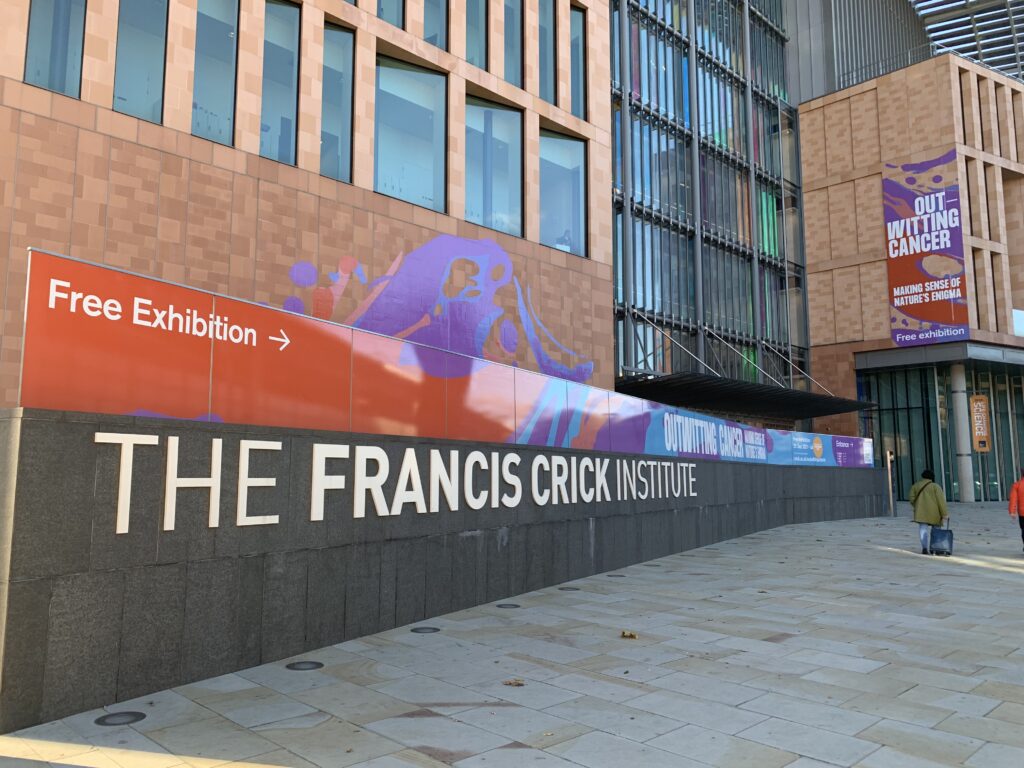
The charity has recently made a £20,000 donation to the Francis Crick Institute to help with their research into the VHL gene. This was made possible by a large fund-raising donation from Mr. Charles White.
In October 2022, the trustees were invited to London to view this incredible facility and to hear from the researchers about the work that they are doing. Charles was able to join us for a short time via video link.
There are two amazing research teams working on VHL at the moment:
From Greg Findlay’s Team:
Our research team at the Francis Crick Institute in London wants to understand how specific genetic changes lead to different cancers. One perplexing feature of VHL Disease is that patients are predisposed to different tumours depending on the exact VHL mutation (or variant) present in their DNA. Despite the fact the VHL gene has been well researched, we still don’t know the extent to which each mutation in VHL is unique. Furthermore, some patients are deemed to have “variants of uncertain significance”, or VUS, in the VHL gene, meaning it’s unclear whether their unique mutation leads to disease, and if so, which features of disease are likely to be seen. If we can learn more about each specific VHL mutation, this knowledge will have a positive impact by reducing the uncertainty caused by VUS and enabling precise treatments tailored to specific patients.
With the help of others, Megan Buckley in my lab has leveraged funding from VHL UK/Ireland to engineer all possible variants in VHL using CRISPR technology. This technological feat allowed us to systematically measure the effects of over 2,000 different VHL mutations in human cells grown in lab. Our data constitute a powerful resource for understanding which VHL mutations lead to cancer and why this happens on the molecular level. We are now integrating these experimental results with data from patients to move towards our overarching goal of improving diagnosis and management of VHL Disease.
From Geoffrey Feng’s Team:
Patients with VHL disease develop tumours in different organs, including the kidney, pancreas and blood vessels. However, the affected organs in individual patients vary, which correlates with different inherited VHL gene alterations along with the genetic background. Currently, it is not understood why and how a specific inherited VHL gene alteration (germline mutation) in a particular patient leads to the development of tumours in certain types of VHL disease-affected tissues but not others.
We collect blood from VHL patients with different VHL germline mutations, and reprogram the blood cells into induced pluripotent stem cells (iPSCs). We can infinitely grow these iPSCs, as well as use genetic editing tools to either correct the inherited alteration, or remove the other copy of VHL gene, which models the first step in the VHL tumour development. More importantly, we can induce (differentiate) iPSCs to become cells of VHL disease-affected organs, including the kidney, pancreas and blood vessels for further gene expression analysis.
Together, we aim to understand for each patient in our representative cohort how the germline VHL mutation either alone or with the removal of the other VHL copy prime the tumour formation in specific organs at the gene expression level. With more patient-derived iPSC lines characterised through this workflow, we can find and test the factors that prevent certain tumour formation in particular patient groups. Finding the differences between the phenotypically different patient groups can provide novel therapeutics insights on how to stop the tumour development of certain VHL-affected tissues in the context of certain VHL germline mutations.
As always, we find that researchers love meeting patients as much as we love meeting them – we are amazed by the work that they are doing; and it really helps them to discuss VHL with people who live with the reality every day. We would like to thank everyone at the Crick for making us feel so welcome that day, taking the time to show us around the labs and to explain their work to us.


