
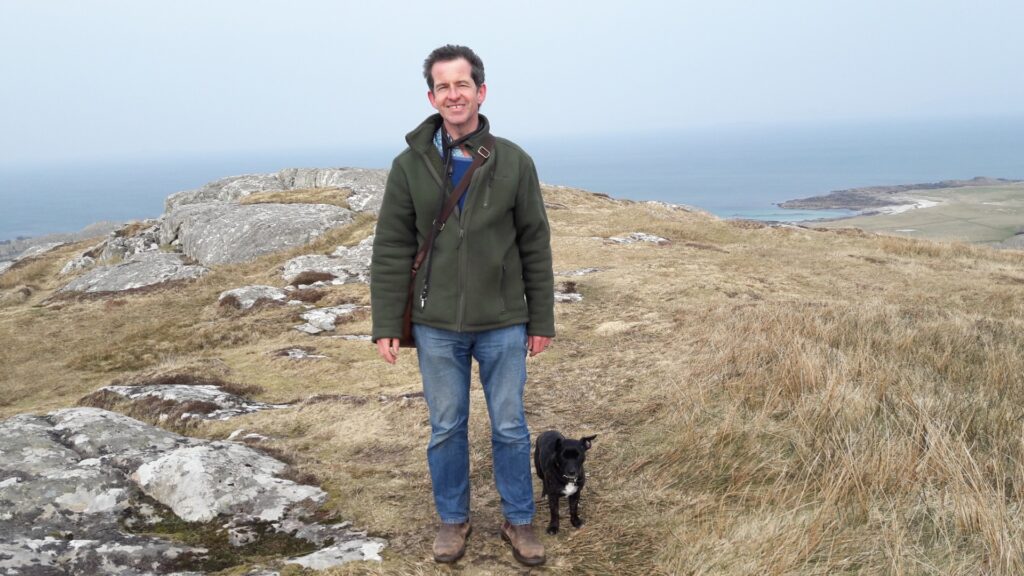
As a small boy growing up in the 1960s there was never any reason given why my mother, an ex-ballet dancer, was in a wheelchair. No one, including her many medical consultants, knew why. It was not until the 1990s when my sister lost sight in one eye that finally, with the help of a visiting American doctor, their VHL was diagnosed.
In the 2000s in my middle age, I was living an active and adventurous life in Borneo leading multi-million-pound projects on issues from forests, peatland and climate change to conflict resolution, and became involved in the reconstruction in Indonesia following the Boxing Day tsunami. However, in 2007 I didn’t feel quite right, and at the suggestion of my father-in-law – who was a practising doctor in Perth, Australia – I went to Perth and to his medical colleagues in search of answers.
The visit to Perth found an orange-sized mass near my left adrenal gland. I returned later in the year to have it removed but lost my first kidney during the operation when a paraganglioma (a specific tumour external to the adrenal gland) was discovered wrapped around my renal artery and vein, and rather more than just my adrenal gland was removed.
At this point, I too tested positive for VHL. Little did I know this was the beginning of the regime of annual scans and regular surgeries that VHL patients come to experience. I also had laser surgery to remove a retinal tumour which felt as though I had been blinded under the harsh Australian sun when I left the ophthalmologists.
My next surgery was to remove a cerebellar tumour in 2012. This was successful and all the tumour was taken out. I recovered in about six months and was able to resume a normal life and continued to live in the back of beyond in Borneo with regular visits to the UK.
But at this time, I had cysts and tumours that would develop into kidney cancer (RCC) growing in my one remaining kidney, which were being monitored by scans. The preferred treatment keeps most of the kidney in place but my largest cyst/tumour was in a place in the kidney that meant I had to lose this last kidney, and with my wife returned to the UK in 2014 as monitoring became more frequent and I needed a transplant. On my wedding anniversary in 2017, I had my second kidney removed and was fortunate to receive a kidney transplant from my brother, who does not have the VHL gene.
Having recovered from that, life continued with consultancy work in Indonesia. However, it was not long before attention shifted to my cerebellum again and the next tumour that was growing there. This was blocking the flow of cerebrospinal fluid (CSF) through the ventricles of my brain giving me hydrocephalus and in 2019 I was given a shunt that allowed the excess CSF to drain into my abdomen. I was offered surgery on the tumour in 2019 but with my consultant we decided to see what the next scan brought. A mix up meant I missed my next scan and I began to develop the symptoms of headache, nausea and vomiting that I knew meant action was needed.
The tumour was now too big and vascular to safely operate, so I was given radiotherapy in mid 2020. This was successful in stopping the tumour growing but caused my brain to swell, putting me in hospital for four months. This was the time of Covid and I had no visitors, and I only saw my wife once during this period when the medical team did not think I would
survive a serious chest infection. Fortunately, I left hospital in 2021 and have not had any more surgeries since then, other than laser surgery on my left eye, which unfortunately was close to my centre of vision (fovea) and has led to a deterioration in my eyesight.
I am now left unable to walk unaided, and spend most of my time sitting on a sofa watching TV. I have had to retire early. I am lucky really, as my wife looks after me marvellously but she too has had to stop paid work because of my condition. My eldest son has the VHL gene and has himself lost the sight in one eye before he was thirty; he now has retinal tumours that need treatment in his other ‘good’ eye. He has had his first brain surgery already to remove a growing lesion. I am proud of him as he has raised thousands of pounds for VHL UK/Ireland and VHL Research including completing an Ironman last year.
We hope NICE will approve Belzutifan, as this is the first drug that gives us the hope that we might control those aspects of our disease that cannot be managed by surgery alone.


